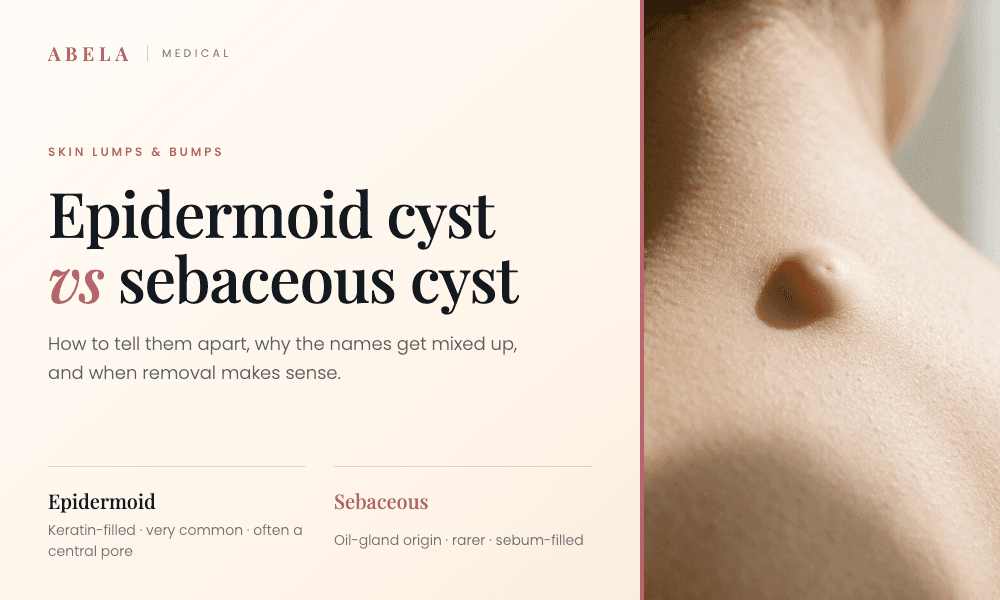
When comparing an epidermoid cyst vs sebaceous cyst, the main point is simple. Most lumps that people call sebaceous cysts are actually epidermoid cysts, which grow from trapped skin cells and fill with a soft protein called keratin. A true sebaceous cyst is much rarer and starts in an oil-producing gland, so it contains an oily fluid instead.
Both lumps will appear almost alike. Both develop beneath the skin and grow slowly. However, the correct name helps your doctor explain what the lump is and how likely it is to come back. This guide provides an easy-to-understand description of the two kinds of lumps, their symptoms, and safe ways to have them removed in the UK.
Key Takeaways
- Most so-called sebaceous cysts are really epidermoid cysts filled with keratin.
- True sebaceous cysts are rare and come from blocked oil glands
- Neither type is cancer, but any new or changing lump needs a medical check
- Removing the whole cyst sac lowers the chance of the lump returning
Epidermoid Cyst vs Sebaceous Cyst: Why the Names Get Mixed Up
For decades, doctors and patients have used the term 'sebaceous cyst' to refer to almost any smooth lump under the skin. Modern skin specialists now avoid that habit. Research shows most of these lumps start in the epidermis, the skin's outer layer, not in the oil glands. That is why the epidermoid cyst vs sebaceous cyst debate exists: one name is common but often wrong, while the other is accurate.
The correct name matters for your records, your histology report and advice on how likely the lump is to return. Both types are benign.
What Is an Epidermoid Cyst?
An epidermoid cyst, also called an epidermal inclusion cyst, forms when surface skin cells slip beneath the skin instead of shedding away. These trapped cells keep making keratin, the same protein found in hair and nails. Over time, keratin builds up inside a thin sac, creating a firm, round lump.
Epidermoid cysts are the most common skin cyst in adults. They often appear on the face, neck, chest, back, and around the ears. Many show a small dark dot in the centre, known as a punctum. If the cyst ruptures, it releases a thick, pale, strongly smelling fluid.
What Is a True Sebaceous Cyst?
A true sebaceous cyst begins inside a sebaceous gland, the tiny structure that makes the oil which keeps skin soft. When the gland or its duct becomes blocked, oily sebum collects and stretches the gland into a sac. Because the contents are oil rather than keratin, the lump can feel slightly softer.
True sebaceous cysts are far less common than epidermoid cysts. The difference between an epidermoid cyst and a sebaceous cyst, therefore, comes down to their origin and contents. Trapped skin cells and keratin sit on one side, blocked oil glands and sebum on the other.

Found a Lump You Cannot Explain?
- A quick, doctor-led assessment brings clarity and peace of mind. The GMC-registered doctors at Abela Medical examine skin lumps, explain what they are, and honestly outline your options.
What Does a Sebaceous Cyst Look Like?
So, what does a sebaceous cyst look like in everyday terms? Picture a smooth, dome-shaped bump just under the skin that moves slightly when you press it. Most range from the size of a pea to a few centimetres across. The colour usually matches the surrounding skin, though the lump may look white or yellow.
An epidermoid cyst often gives itself away with a central punctum, the small dark opening on the surface. A true sebaceous cyst rarely shows this dot. The NHS advises seeing a GP about any skin lump you cannot identify, even when it causes no pain.
Here is a quick comparison at a glance:
| Feature | Epidermoid cyst | True sebaceous cyst |
|---|---|---|
| Origin | Trapped surface skin cells | Blocked oil gland |
| Contents | Thick keratin | Oily sebum |
| Central dot (punctum) | Often present | Usually absent |
| How common | Very common | Rare |
| Typical sites | Face, neck, chest, back | Areas rich in oil glands |
Pilar Cyst vs Sebaceous Cyst: The Scalp Clue
Many people confuse pilar cysts and sebaceous cysts, since both often refer to bumps on the scalp. Pilar cysts develop from cells at the base of a hair follicle, which is why they are mostly seen on the scalp.
Like epidermoid cysts, pilar cysts contain keratin rather than oil. So although people often call them sebaceous cysts, pilar cysts are a separate type with their own pattern and behaviour.
Warning Signs of an Infected Sebaceous Cyst
Any skin cyst can become infected, whatever its true type. An infected sebaceous cyst turns red, feels warm, and becomes tender or painful within a day or two. The lump may swell quickly, and thick, unpleasant-smelling fluid may leak from the surface. On black or brown skin, the redness may be harder to spot, so warmth and pain are useful clues.
Seek medical attention immediately if you experience any of the following symptoms:
- Pain, warmth, or inflammation surrounding the cyst
- Darkened skin around the cyst
- A foul-smelling discharge from the cyst
- Feelings of illness or fever
Do not try to squeeze the cyst yourself. Squeezing can push the cyst deeper under your skin, spread infection, and increase the risk of scarring.
Is a Cyst Sore, Swollen, or Growing?
- Doctor-led assessment in a CQC-regulated Leeds clinic
- Honest advice on whether removal is right for you
- Careful surgical technique to minimise scarring

How Do Doctors Diagnose the Type of Cyst?
Diagnosis usually starts with a simple visual and physical examination. The doctor checks the size, position, and feel of the lump, and looks for the tell-tale punctum. In most cases, this is enough to identify the cyst with confidence.
The key difference between an epidermoid cyst and a sebaceous cyst is that the cyst's contents largely determine the removal procedure. For large or unusual lumps, the doctor may order an ultrasound scan. Afterwards, the removed tissue can be sent to the laboratory for histology.
Sebaceous Cyst Removal and Epidermoid Cyst Removal: Your Options
Not every cyst requires treatment. Monitoring is enough if there is no pain. The cyst may improve on its own. Treatment becomes necessary if the cyst grows, causes pain, becomes repeatedly infected, or causes an aesthetic problem.
Clinics offer several approaches:
- Watchful waiting. The doctor records the size and reviews the lump if it changes.
- Incision and drainage. For an inflamed cyst, a small opening releases the built-up fluid and eases pressure. The sac stays behind so that the cyst may refill later.
- Minimal excision. A small cut allows the doctor to empty the cyst and remove the sac, keeping the scar as small as possible.
- Complete surgical excision. The doctor numbs the area with local anaesthetic, then removes the whole cyst together with its capsule. Removing the entire sac greatly reduces the risk of the lump returning.
Sebaceous cyst removal and epidermoid cyst removal follow the same process at Abela Medical: a consultation, a 30- to 60-minute procedure, and written aftercare instructions. Recovery is expected within one to two weeks. Doctor-led cyst removal in Leeds starts from £350, and we confirm your final price at consultation. The procedure carries risks, including bruising, infection, scarring, or recurrence.
Conclusion
The difference between an epidermoid cyst and a sebaceous cyst boils down to one basic fact. Most lumps labelled as sebaceous cysts are actually epidermoid cysts, which consist of trapped skin cells and keratin. Sebaceous cysts are uncommon, filled with an oily substance, and arise from a gland. They are benign but can become infected and may require surgical treatment.
If the lump keeps growing or you have any doubts, your next step should be to seek professional medical help. GMC-registered doctors from Abela Medical perform cyst removal in Leeds with surgical precision and straightforward, doctor-led consultations throughout the process.
FAQs
Are epidermoid cysts cancerous?
No. Epidermoid cysts are benign, and the NHS confirms skin cysts are not cancer. Your doctor may still send removed tissue for testing, particularly if a lump looks unusual.
Can a sebaceous cyst go away on its own?
Some smaller cysts resolve spontaneously. Many do not disappear because the sac remains beneath the skin. A doctor can guide you accordingly.
How can you tell a cyst from a lipoma?
A cyst is closer to the skin's surface; it feels firm to the touch, and sometimes a small dark spot is visible in the centre. A lipoma sits deeper beneath the surface, feels soft like dough, and moves with gentle pressure.
Should you pop a sebaceous cyst at home?
No. Squeezing a cyst injects keratin or sebum into the surrounding tissue, which can lead to infection and, in most cases, leave the cyst behind.
Does cyst removal leave a scar?
Yes, any wound to the skin will result in a scar, but experienced surgeons make tiny incisions and place them so scarring is barely noticeable. Everyone heals differently.
What should you do if an infected cyst bursts?
Wash the area with warm water, apply a dressing, and schedule an appointment with a doctor, who may prescribe antibiotics and arrange removal of the sac once the infection is gone.