

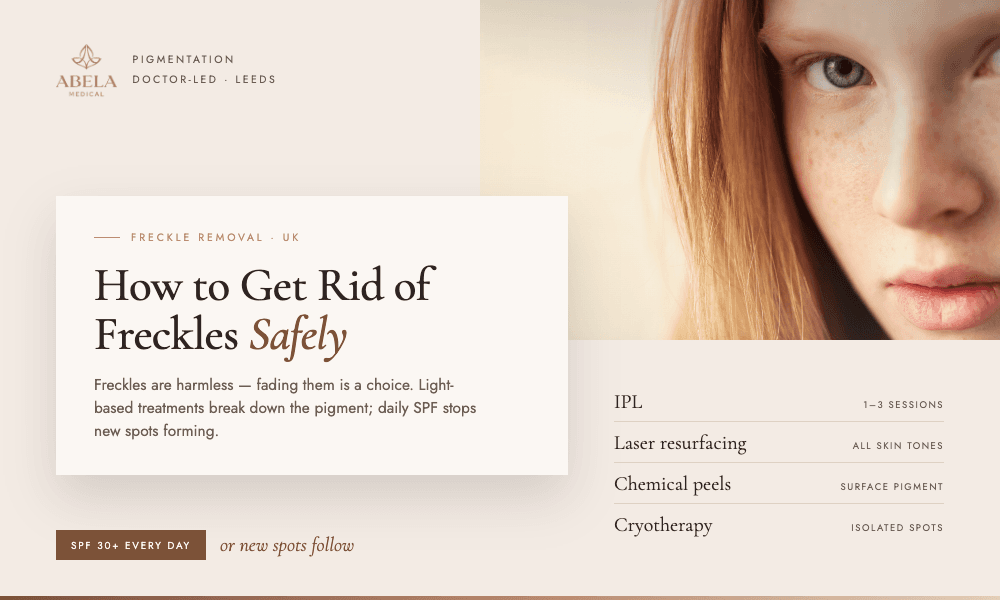
When you ask how to remove freckles, the truth is that it requires a combination of professional care and proper daily sun protection. Light therapy techniques like IPL and laser therapy help dissolve excess pigment in the spots, while chemical peels remove the pigmented surface layer of skin cells. Since freckles are harmless, removal is a cosmetic preference, not a requirement.
Consistent results also require care post-treatment. Freckles form from sun exposure; therefore, new spots can appear whenever skin is unprotected. This guide explains why freckles form, the professional methods used to remove them, and how to protect your skin to prevent freckles in the future.
Key Takeaways
- Freckles are harmless patches of extra pigment triggered by sunlight
- Professional options such as IPL, laser resurfacing, chemical peels and cryotherapy can fade them
- Daily SPF 30 protection helps stop new freckles from forming
- A doctor should check any spot that changes shape, size or colour
How to Remove Freckles: What Really Works
Professional freckle removal targets melanin, the pigment that makes each spot darker than the surrounding skin. Clinics use focused light or controlled exfoliation to break that pigment down so the body can clear it naturally. Most people want to know how to get rid of freckles on the face, and facial skin usually responds well because the spots sit close to the surface.
The main clinic options include:
- Intense pulsed light (IPL): devices such as Lumecca flash filtered light into the pigment, which darkens briefly and then flakes away.
- Laser skin resurfacing: removes the fine, pigmented outer layer and encourages fresh, even-toned cells to grow.
- Chemical peels: exfoliate the discoloured surface cells over about a week.
- Cryotherapy: freezes individual spots with liquid nitrogen so they crust and fade as the skin recovers.
What Are Freckles?
Freckles are small, flat, tan or light brown spots that occur on areas of skin exposed to the sun. Medically called ephelides, they result from increased melanin production in small groups of skin cells and commonly occur on the face, shoulders, arms, and hands.
Common characteristics of freckles include:
- Smaller than 5 mm
- Flat, not raised
- Tan, light brown or reddish in colour
- Darker in summer, paler in winter
- Scattered in clusters
Darker, larger spots that occur later in life are generally called solar lentigines, commonly known as age spots. These spots look similar but behave differently: they stay dark year-round and hardly fade.
Fed Up With Pigmentation That Creams Cannot Shift?
- Abela Medical's doctor-led team first checks your skin type, then matches you with the safest way to fade stubborn spots
What Causes Freckles?
Understanding what causes freckles makes them far easier to manage. Each spot is a tiny cluster of melanin produced by pigment cells in response to ultraviolet (UV) light.
Four factors matter most:
- Sunlight. UV rays push pigment cells into overdrive, and the extra melanin accumulates in small patches rather than spreading evenly.
- Genetics. Variations in the MC1R gene make freckling far more likely, which is why freckles often run in families.
- Skin type. People with fair skin, red or blonde hair and light-coloured eyes freckle most easily.
- Age and season. Freckles usually first appear in childhood and multiply during sunny months.
Because sunlight drives the process, protection matters just as much as treatment. Fading existing spots without changing sun habits usually means new ones follow.
Freckles vs Moles: How to Tell the Difference
Confusion between the two is common, so it is important to understand freckles vs moles before deciding on removal. Freckles are flat areas of pigmentation, while moles are growths caused by clusters of pigment cells. Normally, adults have about 10 to 40 moles.
| Feature | Freckles | Moles |
|---|---|---|
| Texture | Always flat | Flat or raised |
| Colour | Tan to light brown | Brown, black or tan |
| Seasonal change | Fade in winter | Stay the same all year |
| Pattern | Scattered groups | Usually single spots |
Both are usually harmless. Even so, ask a doctor to check any spot using the ABCDE rule: Asymmetry, Border, Colour, Diameter and Evolving. Book a prompt review if a mark develops ragged edges, shows mixed colours, grows beyond 6 mm, or keeps changing. A quick professional check can pick up anything more serious, including skin cancer, at an early stage.
Do Freckles Go Away on Their Own?
So, do freckles go away on their own? Often, partly. Classic freckles noticeably fade each time UV levels drop, and many soften further with age. Some childhood freckles disappear almost completely by adulthood.
Sun-related spots react differently. Age spots don't move and gradually darken. Persistent freckles that don't change with the seasons and are covered year-round respond well to professional lightening procedures.
Not Sure Which Treatment Suits Your Skin Tone?
- A doctor-led consultation at Abela Medical matches IPL, laser or peels to your exact skin type, never a one-size-fits-all plan
Professional Freckle Removal Treatments
There is more than one route to clearer, more even skin, and clinics often combine approaches. A practitioner recommends the right option after assessing your skin in person.
IPL for Freckles
The IPL treatment is commonly used to treat freckles on light or medium skin tones. Light enters the freckles, where melanin absorbs it and breaks it down. After treatment, freckles usually darken for 3-4 days, then flake away to reveal new skin over 1-2 weeks. You usually need 1-3 treatments and can return to work straight away.
Because IPL targets melanin directly, it suits light to medium skin tones best; your practitioner may recommend laser resurfacing instead for darker skin.
Laser Freckle Removal
Laser freckle removal works by resurfacing. The laser lifts away the fine, pigmented outer layer of skin and prompts fresh, even-toned cells to replace it. Newer cold-fibre fractional lasers keep the surrounding tissue cool, which shortens recovery to a few days and makes treatment suitable for all skin tones. Results build gradually over four to six weeks as the skin renews itself.
Chemical Peels
The professional peel uses a specially formulated solution that exfoliates the damaged outer layer of the skin. After mild peeling occurs for several days, the skin appears brighter. A series of milder peels proves more effective for sensitive skin than a single intensive procedure.
Cryotherapy
This procedure involves applying liquid nitrogen to specific areas of the skin. The affected area crusts briefly and peels off as new skin grows. This procedure is most suitable for isolated spots such as freckles and other pigmented marks.
Skin creams by prescription
Some people like topical treatment methods. Doctors prescribe these creams only after a proper examination, and they are prescription-only in the UK. The results come in slowly over several months.
Whichever route you choose, results build gradually, and no clinic can promise freckles will never return. Avoid direct sun for at least 2 weeks after light-based treatments to protect healing skin.
How to Prevent Freckles
Preventing freckles is key to maintaining your natural skin and any future treatments. This requires keeping UV radiation exposure to a minimum:
- Use a broad-spectrum SPF 30+ sunblock every day
- Look for products that have a 4-star UVA rating
- Limit the time spent outside between 11 am and 3 pm in the period from March to October
- Wear a wide-brim hat and sunglasses in very sunny conditions
- Do not use sun beds
NHS advice on sun safety confirms that you can burn your skin in the UK, even on an overcast day.
Conclusion
Getting rid of freckles comes down to two things: professional fading treatments and consistent sun protection. IPL, laser resurfacing, peels, and cryotherapy all reduce existing spots, while daily SPF use prevents new ones from forming. Freckles are harmless, so take your time, ask questions and choose what feels right for your skin.
For a doctor-led plan matched to your skin tone, the team at Abela Medical provides UltraClear laser treatment in Leeds, along with IPL, peel, and cryotherapy options. Every plan begins with an honest skin assessment.
Frequently Asked Questions
Can freckles be removed permanently?
Freckles may fade or be eliminated with treatment, and some may never come back. But since skin prone to freckles will always develop more when exposed to sunlight, no facility can guarantee a permanent outcome.
Is laser freckle removal painful?
People mostly feel a warm, flicking sensation rather than pain. A numbing cream is always used before deeper procedures, while IPL treatment usually doesn't require numbing.
How many sessions does freckle removal take?
Depending on the light procedure, 1 to 3 sessions are required, with a gap of a few weeks between sessions.
How do I get rid of freckles on my face?
Facial freckles respond well to IPL, laser resurfacing or a course of peels because the pigment sits close to the surface. A doctor first assesses your skin type, and daily SPF 30 helps prevent new spots from forming.
Do freckles fade with age?
Classic childhood freckles often soften as people get older. Sun-induced patches such as age spots tend to do the opposite and become more noticeable over time.
Are freckles a sign of sun damage?
Freckles show that your skin reacts strongly to UV light. They are harmless on their own, but they are a useful daily reminder to wear sunscreen.
Can home remedies remove freckles?
Popular remedies such as lemon juice lack reliable evidence and can irritate or even burn the skin. Professional treatments are safer and far more predictable.