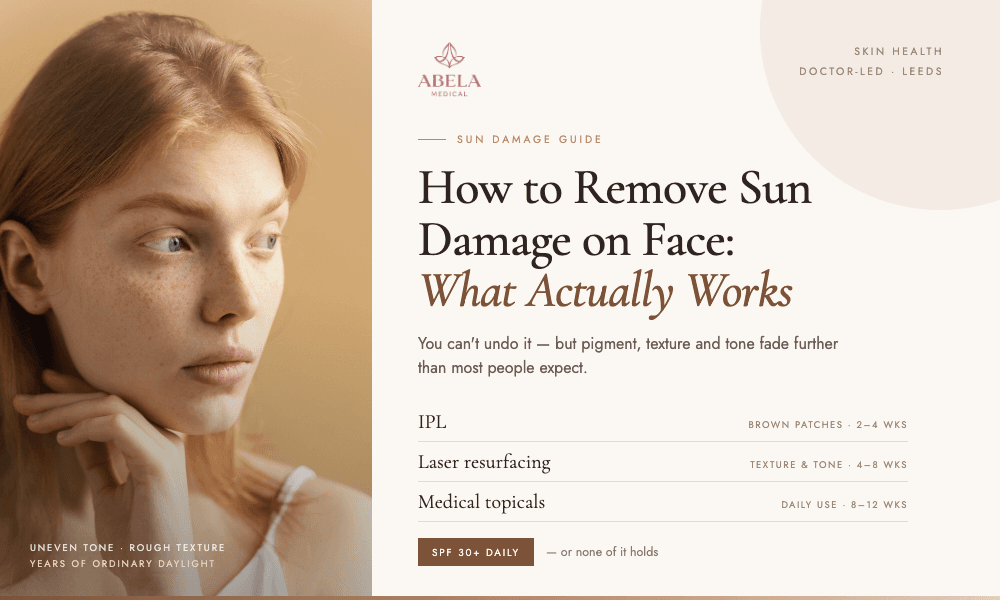
You can't fully remove sun damage on the face. You can fade it, though, and usually by more than people expect. A mix of clinic treatment and daily skincare lifts dark patches, smooths rough skin and evens out your tone over a few months.
It builds up slowly, which is why it catches people out. Most of what shows on your face didn't come from one bad holiday. It came from years of ordinary daylight, a bit at a time, so that it won't clear up on its own either. Skin does respond well once you start, mind you.
Key Takeaways
- Sun damage doesn't go away for good, but it can fade a long way
- Creams work. Clinic therapies are more effective.
- Nothing you gain lasts without daily SPF
- Give it 8 to 12 weeks before you judge the results
- A patch that won't heal is a doctor's job, not a facial
Sun Damaged Skin Treatment Options
What you pick depends on whether the colour or the texture bothers you more. Most sun-damaged skin treatment plans use something for pigment alongside something that works deeper.
| Treatment | Best for | Sessions | Downtime | Visible change |
|---|---|---|---|---|
| Medical-grade topicals | Mild tone and early lines | Daily use | None | 8 to 12 weeks |
| Chemical peel | Surface dullness, uneven tone | 3 to 6 | 2 to 7 days | 4 to 6 weeks |
| IPL (Lumecca) | Brown patches, redness, visible veins | 2 to 4 | 1 to 3 days | 2 to 4 weeks |
| Laser resurfacing (UltraClear) | Texture, pigment and lines together | 1 to 3 | 3 to 7 days | 4 to 8 weeks |
| Radiofrequency microneedling (Morpheus8) | Deeper texture and firmness | 2 to 3 | 2 to 5 days | 8 to 12 weeks |
A few things worth knowing before you book anything.
IPL uses light to break up brown pigment, so it handles sun spots and patchy tone well. It's the wrong choice for melasma. The heat tends to make that worse rather than better.
Laser resurfacing removes the damaged outer layers and prompts the skin to produce new collagen beneath the surface. Newer cold fibre systems run cooler than older lasers, so you're back to normal sooner.
Chemical peels work on surface colour. Depth varies enormously, which matters more than people realise, because one clinic's peel means a weekend indoors and another's you'd barely notice.
Radiofrequency microneedling goes deeper. Texture and firmness, mostly. It won't do much for colour.
One more thing. Darker skin contains more pigment, so light and heat treatments can leave dark marks if the settings are wrong. A good clinic will turn the energy down and patch test first.
What Sun Damage Does to Your Skin?
Sunlight gets through more than you'd think. Clouds don't stop it. Neither does glass, which is why the side of your face nearest the car window often looks older than the other side.
Underneath, two things go wrong at once. UV breaks down collagen and elastin, so skin loses its firmness. It also throws off the way your skin produces pigment, leaving the colour patchy. Both happen together. That's why sun damage turns up as rough skin and uneven tone rather than one or the other.
On the face it tends to look like:
- Darker patches, usually across the cheeks, nose and forehead
- Blotchy tone
- Skin that feels rough, sometimes almost leathery
- Lines that turned up earlier than they should have
- Tiny red veins around the nose
If it's the separate dark marks that bother you most, there's more detail on the age spots page.

Tired of Skin That Looks Older Than You Feel?
- A full skin assessment, not a sales pitch
- Treatments matched to your skin type and tone
- Honest advice if something won't suit you
Can Sun Damage Be Reversed?
No, not entirely. Ultraviolet light damages the DNA in skin cells, and there is nothing that can reverse it.
The only thing that can be changed is its appearance. The pigment starts breaking down and disappears. The collagen gets restored. Dead layers of skin peel off, and new, smoother layers emerge in their place. Thus, when it comes to the question of whether the effects of sun damage can be reversed, the truthful answer is that they cannot.
Worth remembering when you're shopping around. Anything sold as a permanent fix isn't being straight with you.
Sun Damage on Face Treatment at Home
Home treatments won't match a clinic device, but they still earn their place. A consistent routine can fade mild facial sun damage and protect the results of any professional treatment.
Five products are strongly supported by science:
- Retinol helps renew skin. This means that newer, healthier skin will be generated to replace the damaged skin. Begin with a milder formulation two to three days a week. More concentrated versions are prescription-based; give your skin time to adapt first.
- Vitamin C acts as an antioxidant. Apply it in the morning before sunscreen to restore uneven skin and increase collagen production.
- Niacinamide reduces redness and improves uneven skin tone. It is appropriate for all skin types, including sensitive skin.
- Azelaic acid is the gentler option for skin that tends to react easily. It will gradually reduce dark spots while causing minimal irritation.
- Lactic acid and glycolic acid exfoliate the skin's outermost layer.
How Long Does Sun Damage Take to Fade?
Depends what you use. It also depends on how deep the damage goes.
Creams are slowest. Eight to twelve weeks before you'd call it obvious, six months for the full picture. Clinic treatments move quicker. Pigment tends to lift two to four weeks after IPL, and skin looks smoother four to eight weeks after resurfacing, once the healing has settled.
Collagen is the slow one. That carries on quietly for three to six months after your last session, long after you've stopped paying attention to it.
One thing undoes all of it. Sun exposure between sessions. Which is why SPF isn't optional partway through a course.
Not Sure Which Treatment Suits Your Skin?
- Skin type and tone checked before anything gets booked
- Straight answers on downtime and how many sessions you need
- A plan you can start slowly and build on

How to Prevent Sun Damage on Face
This is the bit everyone skips. It's also the bit that decides whether any of the rest holds.
- SPF 30 or higher, broad spectrum, every single day. Yes, in January too
- Top it up every couple of hours if you're outdoors
- Hat and sunglasses when the sun's strong
- Stay out of it between 11 am and 3 pm from late spring through to early autumn.
- No sunbeds
Windows are the blind spot. UVA passes straight through glass, so drivers collect damage down one side of the face and desk workers collect it from the window seat, all without ever feeling warm.
When Sun Damage Needs Medical Attention
Most sun damage is cosmetic. Some of it isn't, and it's worth knowing where the line sits.
See a GP or a dermatologist rather than a cosmetic clinic if you notice:
- A rough, scaly patch that won't heal, especially on the nose, ears or forehead
- A mole that's changed shape, colour or size
- A sore that bleeds, scabs over, then comes back
- Any new mark that looks unlike everything else on your skin
Rough, scaly patches on sun-exposed skin may be actinic keratoses. It's treatable, and now and then it turns into skin cancer if it's left alone, so it's worth a look. A facial won't touch it and might hold up a proper diagnosis.
Conclusion: So, how do you remove sun damage on face?
This is not precisely how you do it. It fades it. Choose the method that works for you, depending on whether it is the colour or the uneven texture. In a clinic, an old scar heals faster than with creams.
If you'd like someone to assess your skin properly, the medical team at Abela Medical in Yeadon provides honest consultations and builds a plan around your skin, not a device. You can book a consultation at the Leeds clinic.
Frequently Asked Questions
Can you fix sun damage on your face?
Not entirely. You can improve how it looks, though. Treatments break up pigment, replace the damaged surface and rebuild collagen, so dark patches and rough texture become far less obvious.
Is sun damage on your face permanent?
The DNA damage is. The look of it isn't. Most people see a real improvement in tone and texture with the right treatment, but it only lasts if you maintain daily sun protection.
Does vitamin C reverse sun damage?
It helps, but it won't reverse it. Vitamin C protects your skin from new damage and adds a bit of brightness to dull patches. For those, you need a retinol cream or a clinic treatment.
How long does it take to see results from sun damage treatment?
Creams and serums take 8 to 12 weeks to show results. Clinic treatments are faster. Dark patches fade within a month of IPL. Smoother skin takes a month or two after a laser treatment.
Can sun damage turn into skin cancer?
Years of UV exposure do raise the risk. Rough, scaly patches known as actinic keratosis can sometimes develop further, so any patch that won't heal needs to be checked by a doctor.
What is the best treatment for sun-damaged skin?
There isn't one best option. IPL is the one for brown patches and redness. The laser does more than just clear rough skin and dark marks. Peels are for dull, tired-looking skin on the surface. Which one you need depends on your skin type and what bothers you most.