

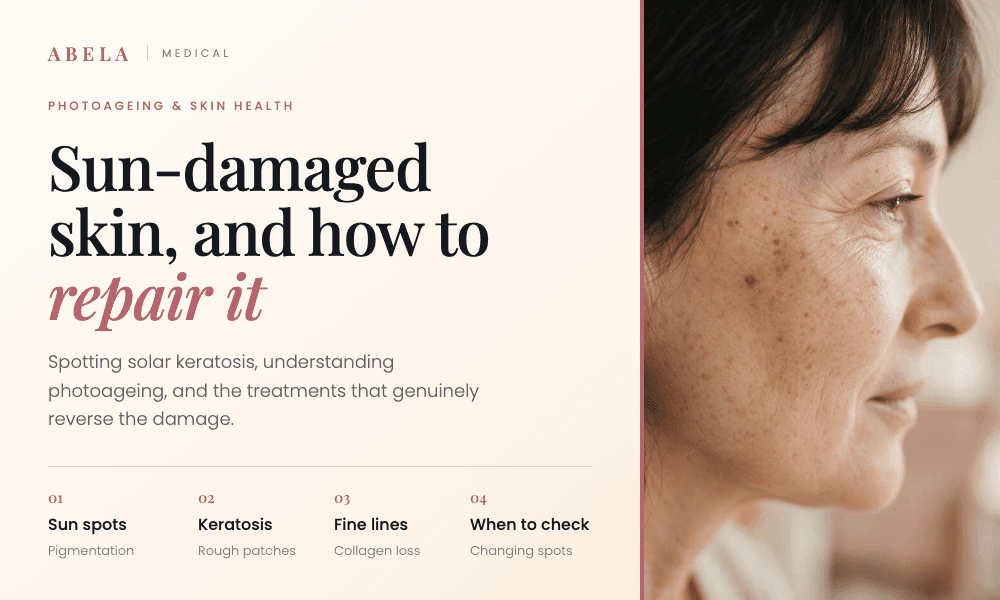
Sun-damaged skin looks like dark patches, rough dry spots and early lines, usually on the face, neck, chest and the backs of your hands. Most of it is only a cosmetic problem. But a few of these changes are worth a doctor's opinion, and telling the two apart is the hard part.
It builds up slowly. UV light weakens collagen and upsets the cells that control your skin tone, and it does this for years before anything shows on the surface. So by the time you notice a brown patch or a rough bit that will not shift, the exposure behind it probably happened decades ago.
Key Takeaways
- Sun damage builds up over decades, so what you see now started years ago
- Brown patches and rough texture usually turn up first
- A scaly patch that will not heal is the one sign worth a doctor's opinion
- Your hands and chest often show it before your face does
- You cannot undo the damage inside the cells, though the look of it can improve a lot
What Does Sun-Damaged Skin Look Like?
It never shows up all at once. You get one change, then another a few years later, and the whole thing creeps up on you.
Here is what tends to appear:
- Brown or tan patches on the cheeks, forehead, chest and hands. Flat, not raised. Most people call these age spots
- Skin that feels coarse instead of smooth
- Fine lines and wrinkles around the eyes and mouth that turned up earlier than they should have
- Thin red lines across the nose and cheeks, from vessel walls that have weakened near the surface
- A general loss of bounce, so the skin sits looser than it used to
- Rough scaly spots that stay put and do not settle down
That last one matters more than the rest. We will come back to it.
None of this happens evenly. Damage lands where the sun lands, which is why one side of your face can look older than the other if you drive a lot.
Why Sun Damage Happens Under the Surface
Two kinds of ultraviolet light reach you, and they cause trouble in different ways.
UVA goes deep. It gets down to the layer where collagen and elastin sit, and those are the two proteins that keep skin firm, so when they weaken, the surface starts to sag and crease. UVA also passes straight through clouds and window glass. That means you pick it up on grey days, in the car, and sat next to a window at work.
UVB is the one that burns you. It hits the top layer and damages the DNA inside those cells, which is what drives most rough patches over time.
Doctors call the whole process photoageing. It happens on top of normal ageing, only faster, and it only affects skin you leave uncovered. Want proof? Compare the back of your forearm with the skin on your upper inner arm. Same age, very different condition.

Not Sure If That Rough Patch Is Anything To Worry About?
- Someone trained looks at the actual spot, rather than guessing from a photo
- You find out what needs treatment and what you can leave alone
- No more weeks of quietly worrying about it
Solar Keratosis on the Face
Here is the one you should not ignore. Solar keratosis on the face shows up as a small rough patch with a dry scaly top, often pink or red, sometimes the same colour as your skin. You tend to feel it before you see it. It sits where the sun hits hardest, so the nose, ears, temples, cheeks and the top of the head if your hair has thinned. Dry skin clears up. This does not. Most cases stay harmless for good, but a small number turn into a type of skin cancer called squamous cell carcinoma, so any patch that hangs around should be checked. It is far from rare, either. In the cooler parts of the UK, roughly one in four people over 60 has at least one, according to dermatology guidance.
Sun Damage on the Hands, Chest and Décolletage
Nearly everyone protects their face and forgets the rest. It shows. Sun damage on the hands often arrives before anything on the face does, because the backs of your hands are out in the open all year, on the steering wheel and on the dog lead and over the garden. That skin is thin, so brown patches and a crepey texture stand out early. Sun damage on the chest and décolletage happens for a slightly different reason. Open collars and low necklines leave the area bare from spring onward, and the skin there holds less oil than your face, so it dries out and creases faster. You end up with a V-shape of mottled brown skin and fine vertical lines through it. Both areas do respond to treatment. They just take longer than the face, so expect a longer course.
Can Sun Damaged Skin Be Reversed?
Partly, and it depends what you mean by reversed.
The damage inside your skin cells is permanent. There is no cream, laser or peel that undoes it. If someone tells you different, they want your money.
What you can change is how it looks, and there is a lot of room there. Pigment breaks up. Collagen can be pushed to rebuild itself so the surface firms again, and rough texture smooths out with the right treatment. So the fair answer is that you cannot reverse sun damage, but you can reduce the appearance of it, and for most people that was the point anyway.
There is a second half to this that people miss. Damage stops when exposure stops. Your skin still repairs itself at any age, so protection from today onward slows down everything that comes next.
Tired Of Brown Patches That Add Years To Your Face?
- Abela Medical works out a plan around your skin type rather than a set package
- Chest and hands get treated too, not just the face
- Everything runs under medical supervision

How to Repair Sun-Damaged Skin
There are two levels to this. What you do at home works on the surface, and clinical treatment gets at the deeper stuff.
Start with the basics:
- Broad-spectrum SPF 30 or higher every morning, all year, not just in August
- A retinoid at night, which lifts cell turnover and slowly fades pigment
- Vitamin C in the morning
- A plain moisturiser to keep the skin barrier happy
Give that three or four months before you decide whether it works. Skin turns over slowly, and nothing here is quick.
For more serious damage, you need more than a cream.
UltraClear laser resurfacing takes off damaged surface layers and works on tone and texture together. Lumecca IPL is the better choice if brown patches and redness are your main complaint, and it can be used on the chest and hands as well. Chemical peels lift the dull outer layer and even things out across a wider area.
Which of those suits you comes down to your skin type, how deep the damage goes and how much downtime you can take. That is a consultation conversation, not a blog one.
When to See a Doctor About Sun Damage
Most of what we have covered can wait. This list cannot. Book an appointment if you spot:
- A rough or scaly patch that has not healed after about a month
- A spot that bleeds on its own, without being knocked
- A sore that scabs over, heals, then comes back in the same place
- Any change to a mole, whether that is size, shape, colour or the edge of it
- A lump that grows, hardens or shifts colour
- Anything that itches or stings for no clear reason
None of that means cancer by itself. It just means someone should look. Caught early, most of these are simple to deal with, often through straightforward minor surgery.
How to Prevent Further Sun Damage
Prevention is cheap, and it works at any age.
- SPF 30 or above on your face, neck, chest and hands each morning
- Reapply every couple of hours if you are outside, and after a swim
- Keep to the shade between 11 am and 3 pm from March through September
- Hat and long sleeves on bright days
- No sunbeds. Not once, not for a holiday
One thing people get wrong: cloud does not protect you. Plenty of UV still gets through on a grey British afternoon, which is exactly why sun damage builds up steadily in Yorkshire and not just on holiday.
Conclusion
The signs of sun-damaged skin include brown spots, rough texture, premature wrinkles, and thread veins. This is mostly just cosmetic damage and easily treatable, but the exception would be the patch that won't heal, bleeds, changes, or recurs, which needs the right diagnosis rather than assumptions.
If you have noticed something and you are not sure about it, Dr Najma Hussain and the team at Abela Medical in Leeds can take a look and talk you through the options. Have a look at the sun damage and pigmentation treatments the clinic offers, or book a consultation and get a straight answer.
Frequently Asked Questions
What are the first signs of sun-damaged skin?
Inconsistent tone and texture are common features. Small brown spots appear on cheeks, chest, and backs of the hands. Coarse skin is another symptom which follows lines and thread veins at a later stage.
Can sun-damaged skin be reversed?
Not fully. The damage inside the cells is permanent. What you can do is reduce the appearance of it, and that often makes a big difference, especially with pigment and texture. Daily sun protection then stops more damage from building up.
How long does it take for sun damage to show on skin?
Years, and often decades. Most people see clear signs from their mid-thirties onward, though the exposure behind it usually happened in childhood and their teens. That delay is why it seems to appear out of nowhere.
Is solar keratosis on the face serious?
Usually not. Most cases stay harmless. A few turn into a skin cancer called squamous cell carcinoma, though; that is why a rough patch that will not heal should be checked rather than left.
Why does sun damage appear on the chest and hands first?
Both areas stay uncovered nearly all year and hardly ever get sunscreen. The skin is also thinner and drier there than on your face, so patches and creping show up sooner.