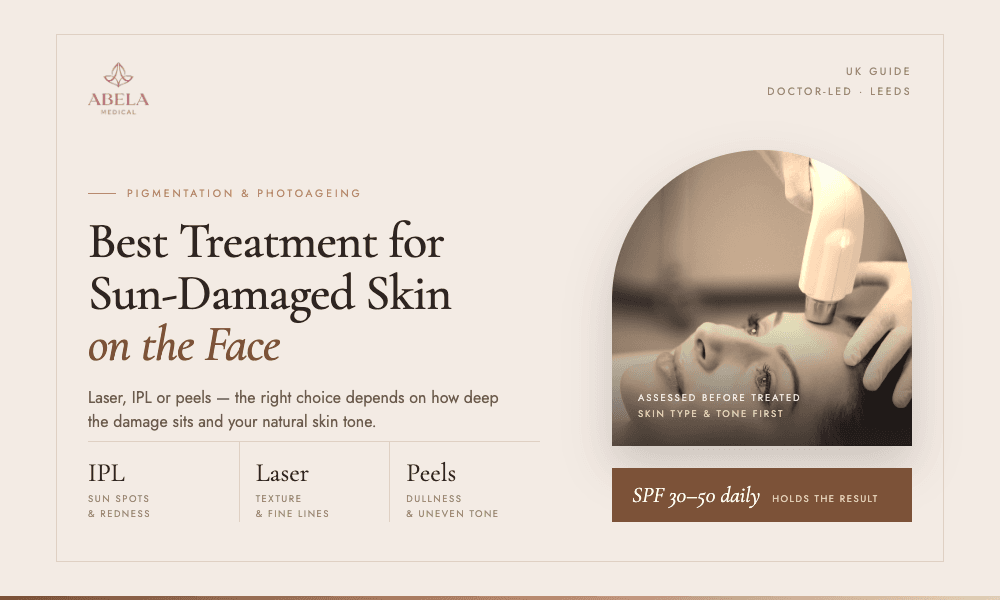
The best treatment for sun-damaged facial skin is usually a combination of professional procedures, such as laser resurfacing, intense pulsed light (IPL), or chemical peels, supported by strict daily sun protection. The right choice depends on how deep the damage sits, your natural skin tone and the results you want.
Sun exposure changes facial skin slowly. Brown patches, rough texture and fine lines often appear years after the exposure that caused them. The encouraging news is that modern clinical treatments can safely and predictably improve many of these changes.
This guide covers everything you need to know about the development of sun damage, its symptoms, and the working principles of each professional treatment so that you can select the best option for yourself.
Key Takeaways
- Laser resurfacing, IPL and chemical peels give the greatest improvement for sun-damaged facial skin.
- Most people need a short course of sessions rather than a single visit
- Daily SPF protects your results and helps prevent new damage from forming
Which Treatment Works Best for Sun-damaged Facial Skin?
No single option suits everyone. Sun-damaged skin treatment works best when it matches the type and depth of the damage, so clinicians assess the skin before recommending any treatment.
As a general guide:
- Surface pigmentation and redness respond well to light-based options such as Lumecca IPL
- Rough texture, fine lines and more serious damage respond best to fractional resurfacing such as the UltraClear laser
- Mild dullness and congestion improve with peels, microneedling and medical facials
- Every plan needs daily sun protection to hold the results
For many people, the best treatment for sun-damaged facial skin is not a single procedure but a planned combination delivered over several months by a qualified practitioner.
What Causes Sun Damage on Facial Skin?
Sun damage builds up gradually. The most common causes include:
- Years of everyday UV exposure without daily sunscreen
- Sunbathing and repeated sunburn, especially in childhood
- Sunbed use, which delivers concentrated UV to the skin
- Outdoor work, sport or long hours of driving
- Fair skin types that burn easily and tan poorly
- Living in or holidaying regularly in strong sunshine
UVA also passes through clouds and window glass, which is why damage develops even in a typical British climate.

Worried About Dark Patches That Keep Spreading?
- Sun spots rarely fade on their own, and the wrong home remedies can worsen pigmentation
- Our doctor-led team at Abela Medical thoroughly assesses your skin and develops a personalised plan based on the assessment
Signs of Sun Damage: Sun Spots, Age Spots and More
The earliest signs are often subtle. Many people first notice sun spots on facial areas that receive the most light, such as the cheeks, forehead, and temples.
What Do Sun Spots Look Like?
Sun spots, known medically as solar lentigines, are flat brown or tan marks with a defined edge. They range from a few millimetres to over a centimetre and tend to darken after each summer.
Age Spots on the Face and Hands
The term age spots on the face and hands refers to the same marks. Despite the name, sun exposure causes them, not age itself. They simply take decades to appear, which is why they show up later in life.
Other common signs of photoageing include:
- Patchy, uneven skin tone
- Rough, dry or leathery texture
- Fine lines around the eyes and mouth
- Small broken capillaries on the cheeks or nose
- A sallow or dull overall colour
One of the most crucial safety points to keep in mind here is that any change in colour or shape, fast growth, itchiness or bleeding should prompt a person to see a doctor or a dermatologist.
How to Repair Sun-damaged Skin: The Science Behind It
If you're wondering how to repair sun-damaged skin, the answer lies in two processes: clearing the damaged, over-pigmented cells and stimulating the skin to rebuild fresh collagen.
Professional treatments achieve this in different ways:
- Targeting pigment. Light energy is absorbed by excess melanin, which breaks the pigment down so the body can clear it.
- Controlled resurfacing. Lasers and peels remove or disrupt damaged surface layers, prompting healthy new skin to replace them.
- Collagen remodelling. Micro-injury deeper in the skin switches on repair pathways, which firm and smooth the skin over three to six months.
Because collagen rebuilds slowly, results continue to improve for months after a course finishes. Patience genuinely pays off with this type of treatment.
Professional Sun Damaged Skin Treatment Options
A clinician will usually recommend one or more of the options below, based on your skin assessment.
Laser Treatment for Sun Damage
Fractional laser treatment for sun damage resurfaces the skin in thousands of microscopic columns, leaving the surrounding tissue intact so healing stays quick. It suits rough texture, fine lines, stubborn pigmentation and overall tone.
Newer cold-fibre fractional lasers, such as the UltraClear system, deliver this resurfacing with less heat than traditional CO2 lasers, which means less discomfort and minimal downtime for most patients. A course of sessions is tailored to the depth of damage.
IPL Treatment for Sun Damage
The IPL treatment process for removing sun damage uses a broad spectrum of light rather than a single laser wavelength. Energy is directed towards dark brown pigmentation and the red vessels, making it suitable for treating sunspots and reddened skin tones.
The treated areas may become darkened for a short period before flaking off over the span of one week. Sessions are usually needed at one-month intervals.
Chemical Peels
Professional chemical peels involve applying an acid to exfoliate damaged skin layers. Light chemical peels are effective at rejuvenating skin that looks dull and patchy, while deep chemical peels treat issues like pigmentation and texture.
Micro-needling and Medical Facials
Micro-needling involves creating micro-channels in the skin to stimulate collagen production. Medical facial treatments help keep the skin clear between aggressive treatments.
Not Sure Which Option Suits Your Skin?
- Honest, doctor-led skin assessments
- Realistic advice on outcomes and downtime
- A step-by-step plan built for your skin tone and goals

Daily Skincare and SPF
Clinical procedures work best on well-prepared skin. A simple routine with vitamin C, a retinol product suited to your skin, and a broad-spectrum SPF 30 to 50 supports each of the options above. A clinician may also recommend prescribed skincare where appropriate, following a face-to-face assessment.
Choosing the Right Pigmentation Treatment for Your Face
A pigmentation treatment for face concerns should always start with an accurate diagnosis, because not all dark patches behave the same way.
Sun spots usually respond well to light- and laser-based care. Melasma, a hormonal pigmentation that sun exposure can worsen, is different: some heat-based treatments can aggravate it, so it requires a more cautious, tailored approach.
Skin tone matters too. The darker the skin colour, the more susceptible the skin is to post-inflammatory hyperpigmentation from aggressive treatment, making it even more critical to use the proper device, settings, and patch test. This is precisely where an expert comes into the picture.
What to Expect: Sessions, Recovery and Risks
Most individuals take a course rather than a single session. As a general guide, courses with fractional lasers typically consist of one to three sessions. In contrast, IPL or peels usually consist of two to four sessions, depending on how far apart they are spaced.
The recovery process is generally simple:
- Redness and slight swelling usually disappear in a few days
- Darkening of the treated pigment followed by its natural shedding
- The skin feels dry and tight as it regenerates
- Strict use of SPF is mandatory during the healing process
There is no medical procedure without any risk. The potential risks associated with this procedure can be:
- Temporary redness, swelling, blisters
- Pigmentation problems
- Occasional infections and scarring
A good consultation, a patch test if necessary, and professional application will help minimise the risks.
How to Protect Your Results and Prevent New Damage
Every treatment regime is more successful if you look after your skin after each application.
- Always use broad-spectrum SPF 30-50 each day, even if it is overcast
- Apply sunscreen when spending a lot of time outdoors
- Use a hat with a wide brim and wear sunglasses on sunny days
- Find shade from 11 am until 3 pm, which is when UV radiation is highest
- Do not use sunbeds
- Inspect your skin every month and report new spots to your doctor
NHS guidelines for looking after your skin in the sun are very practical and useful.
Final Thoughts on Treating Sun-Damaged Facial Skin
The optimal way to repair sun-damaged facial skin is to combine treatments with daily sun protection. Deeply rejuvenating the skin's appearance and texture and addressing fine lines is best achieved through fractional laser treatment. IPL can help reduce skin pigmentation and redness, and peels can help lighten the skin.
Begin with a skin analysis, have reasonable expectations, and pick a doctor-run centre that offers both the positive and negative aspects of the process. The doctor-led treatment team at Abela Medical in Leeds offers laser treatment for sun damage, as well as IPL, peels, and professional skincare.
Frequently Asked Questions
Can sun-damaged skin on the face be reversed?
It can be improved significantly, even if it is not fully reversible. Lasers, IPL, and peels address most of the damage, but prevention is vital for the rest of the work.
What do skin specialists usually recommend first?
A full skin assessment, daily broad-spectrum SPF and a tailored course of professional treatment matched to the type and depth of damage.
How long does it take to see results?
Pigmentation usually improves within two to four weeks after treatment, while texture and firmness continue to improve over three to six months as collagen is restored.
Are sun spots and age spots the same thing?
Yes. They are both called solar lentigines, meaning flat brown spots resulting from UV exposure rather than ageing.
Is laser or IPL better for sun damage?
IPL works well on surface pigmentation and redness, while fractional laser works on texture and lines. Often, a combination of the two gives the best results.
Can sun damage lead to skin cancer?
Long-term UV exposure raises the risk. See your GP promptly about any spot that changes shape or colour, grows, itches or bleeds.