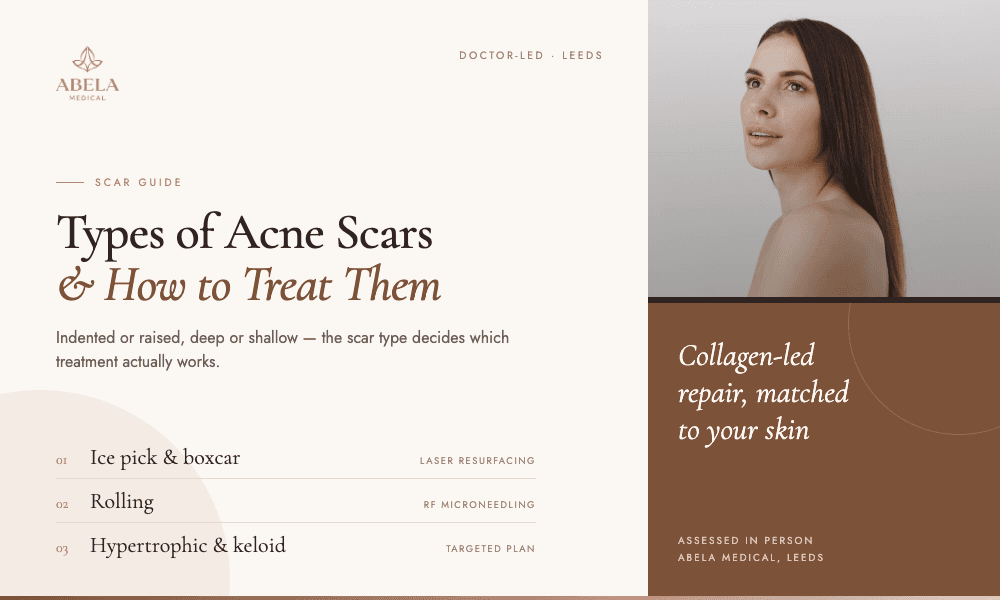
The two categories of acne scars are atrophic scars, which lie below the skin, and raised scars, which lie above the skin. The three types of atrophic scars are ice pick, boxcar, and rolling. There are also hypertrophic and keloid scars, both of which are raised and require specific treatment for each type.
A professional will always ensure that the treatment is tailored to the type of scar you have. Scars that are deep and narrow would require laser treatment, while those that are wide and shallow would benefit from collagen-stimulating treatment. This resource will help you understand the various types of acne scars and what type of scar you have.
Key Takeaways
- Acne scars fall into two groups: indented (atrophic) and raised (hypertrophic or keloid)
- Ice pick, boxcar and rolling scars each respond to different treatments
- Microneedling, laser resurfacing and chemical peels rebuild collagen and smooth the skin
- No treatment removes scars completely, but most people see a clear improvement
Understanding the Different Types of Acne Scars and Their Treatment
Acne scars form when a spot damages the deeper layer of the skin and the body repairs it imperfectly. Too little collagen during healing creates an indented scar. Too much collagen creates a raised scar. The type of scar you have determines which treatment offers you the best chance of smoother skin.
This is why the significance of an accurate assessment cannot be ignored. For example, microneedling for acne scarring is ideal for addressing broad but shallow scars, as it promotes collagen production in that area. However, for deep but narrow scars, an entirely different approach is needed.
What Causes Acne Scars?
Acne scars form due to inflammation from an outbreak that affects the skin beneath the surface. Some of the reasons that increase the likelihood of developing scars include:
- Extreme Inflammation: Severe forms of acne, such as nodules and cysts, cause more damage than mild forms like blackheads.
- Squeezing spots: Bursting a spot tears the skin, pushes bacteria deeper, and disturbs the natural healing process.
- Delaying the treatment process: Prolonged breakouts, which can last for several months, lead to repetitive scarring in the same spot.
- Genetic makeup: Some individuals are naturally more prone to scarring due to differences in their skin-healing process.
- Constant skin-picking behaviour: Touching and picking at healing blemishes causes further harm.

Frustrated That Creams Are Not Changing Your Scars?
- Skincare works on the surface, but true scars sit deeper
- The doctor-led team at Abela Medical assesses your scar type and develops a plan that targets the right depth for your skin
The Main Types of Acne Scars
Most people have a mix of scar types on their face. Knowing the differences helps you understand which treatments your practitioner may suggest.
Ice Pick Scars
Ice pick scars are deeper, narrower scars that resemble small punctures in the skin. They develop from infections that penetrate deep into the skin and destroy the dermal-epidermal junction. As they go deep into the skin, lotions do not help treat them, and they resist superficial treatments. Laser treatment for acne scars is usually performed in clinics.
Boxcar Scars
Boxcar scars are broader and have sharp borders, appearing mostly on cheeks and temples, which are thicker parts of the skin. They vary in depth, and the shallower ones are effectively treated by resurfacing.
Rolling Acne Scars
Rolling scars create an uneven skin surface. The formation of scars beneath the skin's surface causes the skin to pull down, resulting in a wavy appearance, particularly under side illumination. Since the surface skin remains healthy most of the time, treatment aimed at releasing the tissue's attachment and stimulating collagen production is effective.
Hypertrophic and Keloid Scars
These scars result from excessive collagen production during the healing process. In a hypertrophic scar, the scar is limited to the area of injury, whereas in a keloid scar, it extends beyond the wound boundary. Common sites for this type of scar include the jawline, chest, shoulders, and back, and it is more common among people with darker skin.
How to Identify Which Type of Acne Scar You Have
Even a cursory glance in natural light will reveal many things. The following is a simple checklist:
- Deep and narrow craters casting small shadows are a sign of ice pick scars
- Wider and sharp depressions are signs of boxcar scars
- Soft, wavy, or rippled skin is an indication of rolling scars
- Raised skin is an indication of hypertrophic or keloid scars
- Red or brown patches that appear flat are mostly pigmentation, and not scars
This last observation is important. Flat skin marks caused by spots fade on their own within a few months, but scars alter the skin's texture and do not improve without treatment.
How Acne Scar Treatment Works
When looking up ways to remove acne scars, the truth is there is no way to get rid of them completely. Professional treatments will only reduce the depth of these scars, smooth out their rough edges, and improve skin texture.
Most treatments that work effectively operate on the same principles: the formation of controllable skin damage to kick-start the healing process and the formation of new collagen. Over time, the formation of new collagen will fill all of the existing indentations.
The effects develop gradually. Remodelling of collagen takes time; therefore, changes take weeks to appear. The treatment usually includes multiple sessions scheduled several weeks apart, and many practitioners use two or more methods in combination to address various scars on the same face.
Not Sure Which Treatment Matches Your Scar Type?
- A doctor-led assessment identifies your exact scar types
- You receive a step-by-step plan with realistic timelines
- The team at Abela Medical explains which options suit you, and which do not

Treatment Options for Acne Scars
Clinics use several proven methods to improve acne scarring. Here are the main options and the scar types they suit.
Microneedling
A medical device such as SkinPen creates thousands of microscopic channels in the skin. This triggers a strong collagen response that gradually lifts rolling and shallow boxcar scars. Expect some redness and mild swelling for a day or two after each session.
Laser Skin Resurfacing
The treatment involves removing specific columns of skin tissue and stimulating the regeneration of the underlying layers. Resurfacing works for deeper boxcar and ice pick acne scars that are beyond the reach of gentler methods. Downtime may vary, as may the increased likelihood of temporary changes in skin pigmentation in certain skin colours.
Radiofrequency Microneedling
Equipment such as Morpheus8 uses tiny needles together with radiofrequency energy. The energy penetrates deeper than traditional microneedling, helping restructure tethered rolling scars. Minor swelling and redness usually subside after several days.
Chemical Peels
A clinical-strength peel exfoliates the damaged outer layers of skin and encourages fresh cell turnover. Peels work best for shallow scarring, uneven texture and post-spot pigmentation. Skin may flake or peel for several days afterwards.
Dermal Fillers
A practitioner administers the hyaluronic acid gel beneath the depressed scars to lift the depressed skin to match the skin's levels around it. The result is instant but not lasting; hence the maintenance procedure.
Plasma Skin Regeneration
Devices like NeoGen Plasma transform nitrogen gas into thermal energy, consequently rebuilding the skin. This technique not only reduces the appearance of the scars but also helps tighten the skin in the treated region. Flushing and peeling are typical during the healing process.
Any medical treatment involves some level of risk. Among the possible adverse reactions are reddening, swelling, darkening or lightening of the treated skin area. A qualified specialist will conduct an examination and explain all the risks involved in the procedure.
How to Prevent Acne Scars
Prevention is always better than cure. These practices help take care of your skin:
- Take prompt action when you have pimples. Fast action prevents the inflammation from becoming severe.
- Avoid squeezing and popping pimples. Squeezing leads to skin damage and the spreading of germs.
- Choose non-comedogenic skin products. Products that won't clog the pores prevent future pimples.
- Shield your skin from the sun's rays. Sun exposure causes healing scars to darken, making them last longer.
- Consult a dermatologist for severe cases of acne. Severe, painful and widespread breakouts require professional help, not harsh cleansing.
Conclusion
The main types of acne scars are ice pick, boxcar, rolling, hypertrophic and keloid scars, and the right treatment depends entirely on which types you have. Microneedling, laser resurfacing, radiofrequency treatments, chemical peels and fillers can all reduce the appearance of scarring, especially when a practitioner combines them in a personalised plan with realistic expectations.
The doctor-led team at Abela Medical provides tailored acne scar treatment in Leeds, assessing your scar types in person and recommending only the options that genuinely suit your skin.
Frequently Asked Questions
What is the most common type of acne scar?
Atrophic scars make up the majority of acne scarring, and ice pick scars are among the most common within that group. Many people have a combination of ice pick, boxcar and rolling scars in the same area of skin.
Do acne scars go away on their own?
Scars that alter the skin texture usually do not heal completely on their own. However, flat red or brown spots on the skin are most likely due to pigmentation rather than scars.
Which treatment helps deep ice pick scars the most?
Deep, narrow scars usually require resurfacing treatments, such as fractional laser therapy, often combined with other methods over a course of sessions. A practitioner will assess the depth of your scars before recommending a plan.
How many microneedling sessions do acne scars need?
Most people need a course of three to six sessions, spaced around four to six weeks apart. The exact number depends on the depth of the scarring and how strongly your skin produces new collagen.
Does laser resurfacing hurt?
Practitioners apply a numbing cream before treatment, so most people describe a warm, prickling sensation rather than sharp pain. Some redness, swelling and tightness are normal for a few days afterwards.
Are acne scar treatments safe for darker skin tones?
Many options work well across all skin tones, but some lasers and peels carry a higher risk of pigment changes in darker skin tones. An experienced practitioner will adjust the device, settings or method to keep your treatment as safe as possible.